
Vulnerability Assessment

What is Vulnerability Assessment?

A vulnerability assessment is the process of defining, identifying, classifying and prioritizing vulnerabilities in computer systems, websites, applications and network infrastructures. Vulnerability assessments also provide an organization with the necessary knowledge, awareness and risk backgrounds to understand and react to threats to its environment.  A vulnerability assessment process is intended to identify threats and the risks they pose. They typically involve the use of testing tools, whose results are listed in a vulnerability assessment report.
Organizations of any size, or even individuals who face an increased risk of cyber attacks, can benefit from some form of vulnerability assessment, but large enterprises and other types of organizations that are subject to ongoing attacks will benefit most from vulnerability analysis.
Because security vulnerabilities can enable hackers to access IT systems and applications, it is essential for enterprises to identify and remediate weaknesses before they can be exploited. A comprehensive vulnerability assessment, along with a management program, can help companies improve the security of their systems.

Security testing will never be an exact science where a complete list of all possible issues that should be tested can be defined. Indeed, security testing is only an appropriate technique for testing the security of web applications under certain circumstances. Our penetration test team will push your system to its limits in a barrage of simulated cyber attacks, discovering every possible vulnerability so that your organization gets the complete picture and 100% of your data is safe.

Why is Vulnerability Assessment important?

The need for vulnerability assessment is mostly driven by the change in the security landscape. With more and more vulnerabilities being discovered every year, organizations and vendors are required to keep their knowledge bases and IT infrastructures as up-to-date as possible to prevent their security status from falling behind.

The numbers don’t lie: in 2017 the total amount of registered vulnerabilities has more than doubled its numbers on 2016, according to the Common Vulnerabilities and Exposures (CVE) database, skyrocketing from 6,447 registered vulnerabilities in 2016 to 14,712 in 2017:

KiK Security vulneralities statistic by year

This is truer than ever for web applications. As the development and availability of new technologies such as APIs, IoT devices increased, the amount of potential risks and threats grows consequently. The total amount of published Cross-Site Scripting (XSS) vulnerabilities in the CVE database increased by 304.83%; from 497 registered in 2016 to 1,151 in 2017:

KiK Security vulneralities by type and year

As for SQL Injection (SQLi) vulnerabilities, the increase was of an astonishing 535,12%.

There is a big difference between assuming you’re vulnerable to a cyber attack and knowing exactly how you’re vulnerable, because unless you know how you’re vulnerable, you can’t prevent it. The vulnerability assessment goal is to close this gap. A vulnerability assessment tests some or all of your systems and generates a detailed vulnerability report. This report can then be used to fix the problems uncovered to avoid security breaches.

A vulnerability assessment provides an organization with details on any security weaknesses in its environment. It also provides direction on how to assess the risks associated with those weaknesses. This process offers the organization a better understanding of its assets, security flaws and overall risk, reducing the likelihood that a cyber criminal will breach its systems and catch the business off guard.

30000 +
Hours Security Experience

Takes 10 000 hours to become an world class expert. Became possible because we adore our work.

120 +
Happy clients

We are preferred provider of cyber security services and products. Strong cyber security is revenue generator.

300 +
Penetration tests

We have found more than a thousand vulnerable web sites, applications and devices.

1000 +
Protected

More than a thousand protected websites, applications and devices from criminals and malicious software attacks.

GET A FREE QUOTE

Types of vulnerability assessments

Vulnerability assessments discover different types of system or network vulnerabilities.Some of the different types of vulnerability assessment scans include the following:

Website Vulnerability Assessments

Identify weak points in a web applications to prevent malicious attacks. Also detects vulnerabilities and missconfigurations in web servers, DNS servers and database servers.

Network Vulnerability Assessments

Identify possible network security attacks.

Host Vulnerability Assessments

Locate and identify vulnerabilities in servers, workstations or other network hosts. This type of scan usually examines ports and services that may also be visible to network-based scans. However, it offers greater visibility into the configuration settings and patch history of scanned systems, even legacy systems.

Wireless Network Vulnerability Assessments

Wireless network scans of an organization’s Wi-Fi networks usually focus on points of attack in the wireless network infrastructure. In addition to identifying rogue access points, a wireless network assessment can also validate that a company’s network is securely configured.

Application Vulnerability Assessments

Test desktop or mobile applications to detect known software vulnerabilities and incorrect configurations in applications.

Database Vulnerability Assessments

Identify weak points in a database to prevent malicious attacks.

What Is Our Testing Methodology?

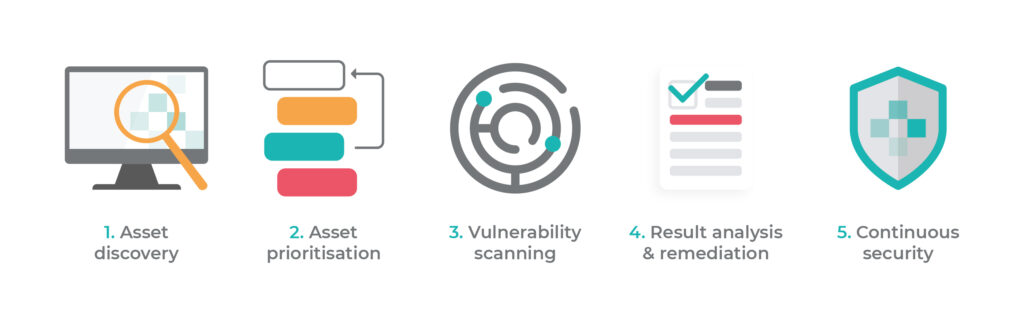
Kik Security vulnerability assessment

1. Asset discovery

One of the most common cyber security challenges facing organizations is a lack of visibility into their digital infrastructure and its connected devices. Some reasons for this include:

Mobile Devices: Smartphones, laptops, and similar devices are designed to disconnect and reconnect frequently from the office, as well as employee’s homes and often other remote locations.
IoT Devices: IoT devices are part of the corporate infrastructure but may be connected primarily to mobile networks.
Cloud-Based Infrastructure: Cloud services providers make it easy to spin up new servers as needed without IT involvement.

We’d all love to work in an organization that was perfectly organized, but the reality is often messier. It can be hard simply to keep track of what different teams are putting online, or changing, at any given point. This lack of visibility is problematic.

2. Prioritization

Once you know what you’ve got, the next question is whether you can afford to run a vulnerability assessment on all of it. In a perfect world, you would be running a vulnerability assessment regularly on all of your systems. Some examples of where you may wish to prioritise are:

  1. Internet-facing servers
  2. Customer-facing applications
  3. Databases containing sensitive information

It’s worth noting that the two of the most common vectors for untargeted or mass attacks are:

  1. Internet facing systems
  2. Employee laptops (via phishing attacks)

So if you can’t afford anything else, at least try to get these covered, in the same order.

3. Vulnerability scanning

Vulnerability scanners initially sends probes to systems to identify:

Open ports & running services
Software versions
Configuration settings

Based on this information, the scanner can often identify many known vulnerabilities in the system being tested.

In addition, the scanner sends specific probes to identify individual vulnerabilities which can only be tested by sending a safe exploit that proves the weakness is present. These types of probes may identify common vulnerabilities such as ‘Command Injection’ or ‘cross-site scripting (XSS)’, or the use of default usernames and passwords for a system.

4. Result analysis & remediation

After the vulnerability scan is complete, the vulnerability assessment provides report. When reading and developing remediation plans based on this report, you should consider the following:

Severity: A vulnerability report should label a potential vulnerability based upon its severity. When planning for remediation, focus on the most severe vulnerabilities first, but avoid ignoring the rest forever. It’s not uncommon for hackers to chain several mild vulnerabilities to create an exploit.
Vulnerability Exposure: Remembering the prioritization above – not all vulnerabilities are on public-facing systems. Internet-facing systems are more likely to be exploited by any random attacker scanning the internet, making them a higher priority for remediation. After that, you’ll want to prioritize any employee laptops with vulnerable software installed. Additionally, any systems that host particularly sensitive data, or could adversely affect your business may need to be prioritized ahead of others.

In most cases, there is a publicly released patch to correct a detected vulnerability, but it can often require a configuration change or other workaround too. After applying a fix, it’s also a good idea to rescan the system to ensure the fix was applied correctly. If it isn’t, the system may still be vulnerable to exploitation. Also, if the patch introduces any new security issues, such as security misconfigurations (although rare), this scan may uncover them and allow them to be corrected as well.

5. Continuous cyber security

A vulnerability scan provides a point in time snapshot of the vulnerabilities present in an organization’s IT infrastructure. However, new deployments, configuration changes, newly discovered vulnerabilities, and other factors can quickly make the organization vulnerable again. For this reason, you must make vulnerability management a continuous process rather than a one-time exercise.

What is difference between Vulnerability Assessment and Penetration test?

Penetration testing is more rigorous and expensive than vulnerability assessment, as it’s essentially a controlled form of hacking. The tester – known as an (white) ethical hacker – works on behalf of an organization and looks for vulnerabilities in its systems.

In that regard, their actual work is much the same way as a criminal hacker. Indeed, unlike vulnerability assessments, penetration tests are designed to identify not only weaknesses but also exploit them.

Doing this demonstrates to an organization exactly how a cyber criminal would infiltrate its systems and what information they could access.

What are the different types of tests?

BLACK BOX TEST
BLACK BOX TEST

Аlso known as a blind test. Requires zero knowledge of the company’s assets. Penetration testers perform a complete reconnaissance phase to uncover the company’s assets and get to pick their own path around security controls as well as executing a strategy of their own.

GRAY BOX TEST
GRAY BOX TEST

In this type of tests,  penetration tester knows the role of the system and of its functionalities, and also knows (though not extensively) its internal mechanisms (especially the internal data structure and the algorithms used). However, he or she does not have access to the source code!

WHITE BOX TEST
WHITE BOX TEST

Consist in reviewing the functioning of an application and its internal structure, its processes, rather than its functionalities. Here, all the internal components of the software or application are tested through the source code, main work base of the tester.

Our Advantages

Our cyber security team will push your system to its limits in a barrage of simulated cyber attacks, discovering every possible vulnerability so that your organization gets the complete picture and 100% of your data is safe.
  • Superior Skills and Experience
  • Reputation
  • Competitive Pricing
  • Results Designed For Real Decisions

Find the Risks. Understand the Consequences. Sleep better.